
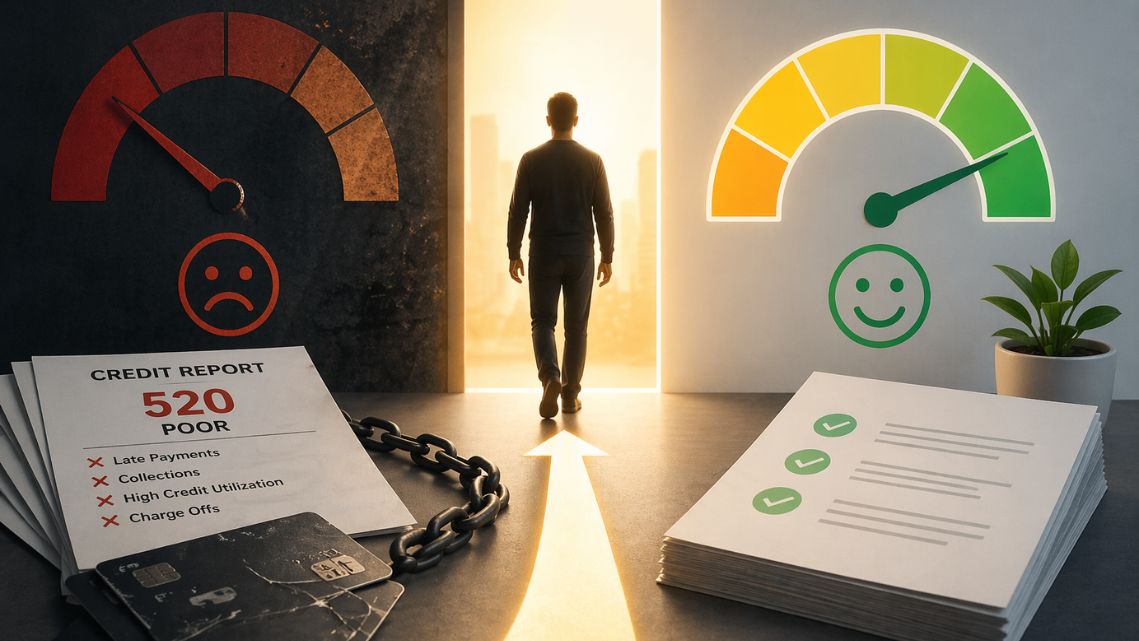
What Does It Mean to Fix Bad Credit?
A solid starting point is knowing exactly how your score is calculated in the first place. Our full breakdown on understanding your credit score walks you through which factors carry the most weight and where your biggest opportunities are.
Step 1: Pull Your Credit Reports and Know Where You Stand
You cannot fix bad credit without first knowing what is actually on your report. You are legally entitled to free credit reports from all three major bureaus through AnnualCreditReport.com. Request reports from Equifax, Experian, and TransUnion and review each one carefully.
As you go through them, watch for:
- Accounts that do not belong to you
- Late payments that were recorded incorrectly
- Collections or charge-offs you do not recognize
- Balances that do not match your own records
- Negative items that are old enough to have aged off your report
Errors are far more common than most people realize, and a single inaccurate mark can knock dozens of points off your score. Catching these early is one of the fastest ways to see results.
For context on what each bureau tracks and how they differ, check out our guide on the 3 major credit reporting agencies.
Step 2: Dispute Errors and Exercise Your Legal Rights
When submitting a dispute, always include a clear written explanation of the error, copies of any documents that support your claim, and your full contact information. For complex disputes involving how a creditor originally reported the data, understanding Metro 2 compliance standards gives you a real edge in the process.
Step 3: Handle Collections and Negative Accounts Strategically
Collections are one of the most common obstacles people face when they want to fix bad credit. But having a collection on your report does not mean you are out of options.
Within 30 days of first contact from a collector, you can request debt validation. If they cannot provide it, they must stop collection activity. In some situations, you may also be able to negotiate a pay-for-delete arrangement, where the collector agrees to remove the account from your report in exchange for a settlement.
The Consumer Financial Protection Bureau provides reliable guidance on dealing with debt collectors legally: https://www.consumerfinance.gov/ask-cfpb/what-should-i-do-when-a-debt-collector-contacts-me-en-1695/
If you are working with outside collection firms, our guide on third-party agencies explains how they operate and what you are entitled to.
Step 4: Build a Consistent and Positive Payment History
Payment history makes up 35% of your FICO score. It is the single most influential factor, which means every on-time payment you make is working in your favor.
Here is what to prioritize:
- Pay at least the minimum on every open account each month
- Set up automatic payments so nothing gets missed by accident
- If you have fallen behind, bring accounts current as soon as possible and stay consistent from that point forward
New positive payment history will not instantly erase what is already there, but over time it steadily dilutes the impact of older negatives. The longer your track record of on-time payments grows, the less your past mistakes will define your score.
Step 5: Reduce Your Credit Utilization
Step 6: Add Positive Accounts to Fix Bad Credit Faster
One of the most overlooked strategies to fix bad credit is proactively adding new positive accounts to your credit profile rather than just waiting for negatives to age off.
Good options include secured credit cards, credit-builder loans, and becoming an authorized user on the account of someone with a strong credit history. Each of these introduces fresh, positive data to your report.
Tradelines are another avenue that is worth understanding before you pursue it. When used correctly, they can add established account history to your report. Our tradelines guide breaks down how they work and what to look out for.
Step 7: Stop Letting Credit Myths Slow You Down
Misinformation about credit repair is everywhere, and believing the wrong things can cost you months of progress or even get you into legal trouble.
Common myths include the idea that you can create a brand-new credit identity to escape a bad history, that paying off a collection automatically removes it from your report, or that checking your own credit score damages it. None of those are accurate.
Separate fact from fiction with our guide on the 10 myths of credit repair and our collection of verified credit facts.
The Federal Trade Commission also publishes reliable information on what credit repair companies can and cannot legally promise you: https://consumer.ftc.gov/articles/credit-repair-how-help-yourself
How Long Does It Take to Fix Bad Credit?
This is the question everyone asks, and the honest answer is: it depends on what is on your report.
Errors and inaccuracies can often be resolved within 30 to 60 days after a successful dispute. More serious issues like multiple collections, charge-offs, judgments, or a bankruptcy can take 12 months to several years of consistent positive behavior before your score reflects the full improvement.
There is no shortcut that skips the work, but there is also no ceiling on how much your score can recover. Progress is possible every single month when you stay the course.
Do You Need Professional Help to Fix Bad Credit?
You can absolutely handle credit repair on your own. Your legal rights, dispute tools, and the strategies outlined here are available to everyone. But working with a reputable credit repair company means having experienced professionals manage disputes, track progress, and apply strategies that are not always obvious without deep familiarity with the system.
At Credit Repair Champ, we have helped thousands of clients make measurable improvements using proven, legal methods. If you are ready to explore professional support, take a look at our pricing options or contact us to talk through your situation.
We also have a referral program if you know someone in your circle who could use help getting their credit back on track.
The Bottom Line
You can fix bad credit. It requires patience, consistency, and the right information, but it is 100% achievable for almost anyone regardless of where their score is starting from. Whether you choose to handle it yourself or get professional support, the most important step is simply deciding to start.
Your credit score is not a permanent label. It is a reflection of your financial behavior up to this point, and it can always be changed. The real question is not whether recovery is possible. The real question is how soon you are ready to begin.